
Ajay Banga was on Wednesday appointed the next president of the World Bank, becoming the first-ever Indian-American to head the global financial institution which said it looks forward to working with him at a time when it's tackling the toughest development challenges facing developing countries. "The executive directors of the World Bank today selected Ajay Banga as president of the World Bank for a five-year term beginning June 2, 2023," the bank said in a press statement. In February, President Joe Biden announced that the US would be nominating Banga, 63, to lead the World Bank because he is "well equipped" to lead the global institution at "this critical moment in history."

'So you have welfare programmes, you reach out to the poor, you cut out the middlemen, you cut out the leakages and you try to raise the standard of living.'
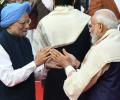
False and acrimonious debates such as Modi versus Manmohan might allow for victories that are political and partisan. But the real loser is the nation, India and Bharat, notes Arvind Subramanian, former chief economic advisor to the Modi government in its first term.
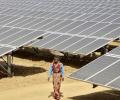
The push given to rooftop solar installation in the Interim Budget ties in with its high rate of adoption in Tier-II and -III cities of India. If original equipment manufacturers (OEMs) in the automobile industry, government, and the solar sector are to be believed, in cities of Rajasthan, Gujarat, and Kerala, 45-50 per cent of electric-vehicle (EV) users are employing rooftop power to charge their vehicles. This is compared to the national average of 25 per cent, say industry sources.

US President Barack Obama on Sunday affirmed his commitment to enhancing India's 'voice and vote' in global financial institutions like IMF.

Coming Wednesday, Finance Minister (FM) Nirmala Sitharaman will present the 2023 Union Budget - the last full Budget ahead of the 2024 Lok Sabha elections. While India exited 2022 as a relatively bright spot in the global economy, the FM will endeavour to present a Budget that insulates India's economy against global headwinds and recession in advanced economies, while sticking to the path of fiscal consolidation. In this, she is being helped by her core team of trusted advisors.

The Indian startup ecosystem has lauded the inclusion of startups in the New Delhi Leaders' Declaration for the first time ever in the history of G20. Industry stakeholders say that the move will lead to easier access to capital, reduce regulatory hurdles, and may revive funding activity. The Declaration, through the Startup20 initiative, recognised startups as "natural engines of growth" and key to socio-economic transformation by driving innovation and creating employment.
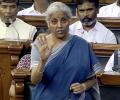
Scheduled commercial banks have written off loans amounting to over Rs 10.09 lakh crore in the last five financial years and the process of recovery of dues from the borrowers continues, Union Finance Minister Nirmala Sitharaman informed the Lok Sabha on Monday.

Opportunity for India to take leadership in economic diplomacy.

The venture is applying to the Reserve Bank of India for approvals.

We asked colleagues, present and past, to reflect on a man who has made such a difference to their lives and careers. Here it is then, a rich collection of memories that offer enchanting glimpses of the enigmatic Ajit Balakrishnan.
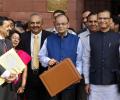
The FRBM report, to be submitted on Tuesday, is likely to have 'excuse clauses', absolving the government of meeting its fiscal commitments under certain conditions such as war or conflict, global economic meltdowns or natural disasters.
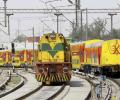
This comes as IR posted its worst operating ratio (money spent to earn every Rs 100) in 16 years, at 96.9 in 2016-17.

India's inclusion in JP Morgan's bond index can channel billions of dollars into India. How will the government securities market handle it?
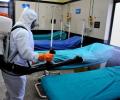
'Most of the testing capacity in India is in the private sector.' 'Whether it is the established RT-PCR test for COVID-19, or it is other innovations in testing that are now coming up, all these are fully within the capabilities of the private sector.' 'Health policy should harness these capabilities,' says Ajay Shah.

The Appointments Committee of Cabinet has named Ravneet Kaur, a Punjab cadre IAS officer of 1988 batch, as chairperson of the Competition Commission of India (CCI). Kaur will hold the post for five years or until attaining the age of 65. She is the second woman to serve in an 'economic regulator' role after Madhabi Puri Buch, who was appointed chairperson of the Securities and Exchange Board of India last year and the first woman to head the country's chief national competition regulator.
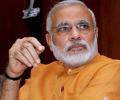
Modi's government plans to support domestic demand

The most immediate challenge for growth is the disruption of the global economy brought about by the Ukraine war and related sanctions, the Covid shutdowns in China and the rising tide of inflation, points out Nitin Desai.

It shows that states would require a compensation to the tune of at least Rs 1.67 trillion in 2024-25, as none of them would be able to achieve a 14 per cent growth every year.

Hospitals empanelled for Modicare may give preference to poor patients over the middle class for fear of strict government action, says Harsh Roongta.
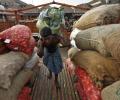
Officials said the government had no option but to cut spending.

Indian society may be more advanced than we think it is, notes Ajit Balakrishnan.

The finance minister chided the central bank on Tuesday over its focus on fighting inflation, saying the Reserve Bank of India (RBI) also needed to abide by the government policy to promote economic growth.

The result is a big blow to the military establishment, revealing the limits of 'political engineering'. It reflected the anger of the electorate, especially its younger voters, who have spoken decisively against the persistent harassment and victimisation of Imran Khan's political party, asserts Rana Banerji, who headed the Pakistan desk at RA&W.

Modi had campaigned with promises of jobs, infrastructure and development.

Modi attended the 20th ASEAN-India Summit in Jakarta. Secretary-General of ASEAN Dr Kao Kim Hourn also attended the summit.
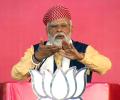
Modi's BJP has promised more revdis or freebies for these assembly elections than ever before, points out N Sathiya Moorthy.

There are various estimates of India's debt to GDP ratio, but the consensus is that that it would be over 80 per cent at the end of the current fiscal year.

Raghuram Rajan is said to have informally written to select policymakers and experts, to curb 'unnecessary' speculation over his future at RBI.
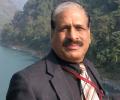
With the two members quitting, the NSC now has only two members -- Chief Statistician Pravin Srivastava and NITI Aayog CEO Amitabh Kant.

Heads of state and big-name billionaires opened the Paris climate summit with a bang on Monday.

They all seem to forget that the Music Academy is as much an independent institution as T M Krishna is an individual musician. In drawing those red lines for the Academy management, they do not even seem to recognise that they too have crossed a red line themselves, points out N Sathiya Moorthy.

The current salary paid by the Delhi government amounts to 17 per cent of the total expenditure.

The Centre has constituted a five-member expert committee to study various alternatives available to it to decide on a new capital for Andhra Pradesh.
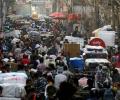
India's macroeconomic situation is certainly better than what it was a year ago, eminent economist Pinaki Chakraborty said on Monday, while expressing hope that the country will be back on the path of economic growth if there is no major third wave of the COVID-19 pandemic. In an interview with PTI, Chakraborty, who is the director of the National Institute of Public Finance and Policy (NIPFP), said that inflation may remain at an elevated level as there was a significant fiscal and monetary expansion in the last 18 months. "The current macroeconomic situation is certainly much better than what it was one year back. We are seeing recovery in most sectors," he said. Chakraborty noted that COVID-19 vaccination has been going on at a very fast rate in India.

The government also appointed Dr Vinod Paul, a pediatrician at the AIIMS, as a member of the NITI Aayog
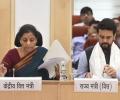
If the protected growth in GST revenue is reduced to 10 per cent, the Centre would save more than Rs 25,000 crore in 2020-21 if none of the states show any revenue growth. This would nearly amount to 0.1 per cent of the gross fiscal deficit and help the government in avoiding fiscal slippage to some extent in subsequent years.

Indian cities need $840 bn investment over 15 yrs, says World Bank report.
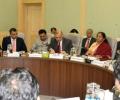
At a pre-Budget meeting, the FM was asked to ensure that NBFCs come out of the liquidity crisis they are facing with the help of RBI. They also spoke about the futility of trying to achieve a 3 per cent fiscal deficit target over the medium term.

For existing technologies, unless appropriate financing is available, deployment at scale is difficult.
 © 2026 Rediff.com - Advertise with us - Disclaimer - Privacy Policy - Sitemap - Feedback - About us - Terms of use - Grievances